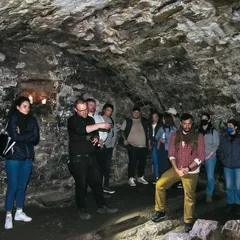
What is under the bridge
The Edinburgh underground vaults: what they are, and which tour gets you in
About a hundred and twenty stone rooms sit inside the arches of a bridge that was finished in 1788. They had no windows, no drains and no ventilation; the businesses that rented them had largely gone by 1795; for the next sixty years they were housing for the poorest people in the city; and then they were filled with rubble and nobody opened them for well over a century. Everything sold as an "Edinburgh vaults tour" exists because a rugby player broke through a wall in the 1980s.
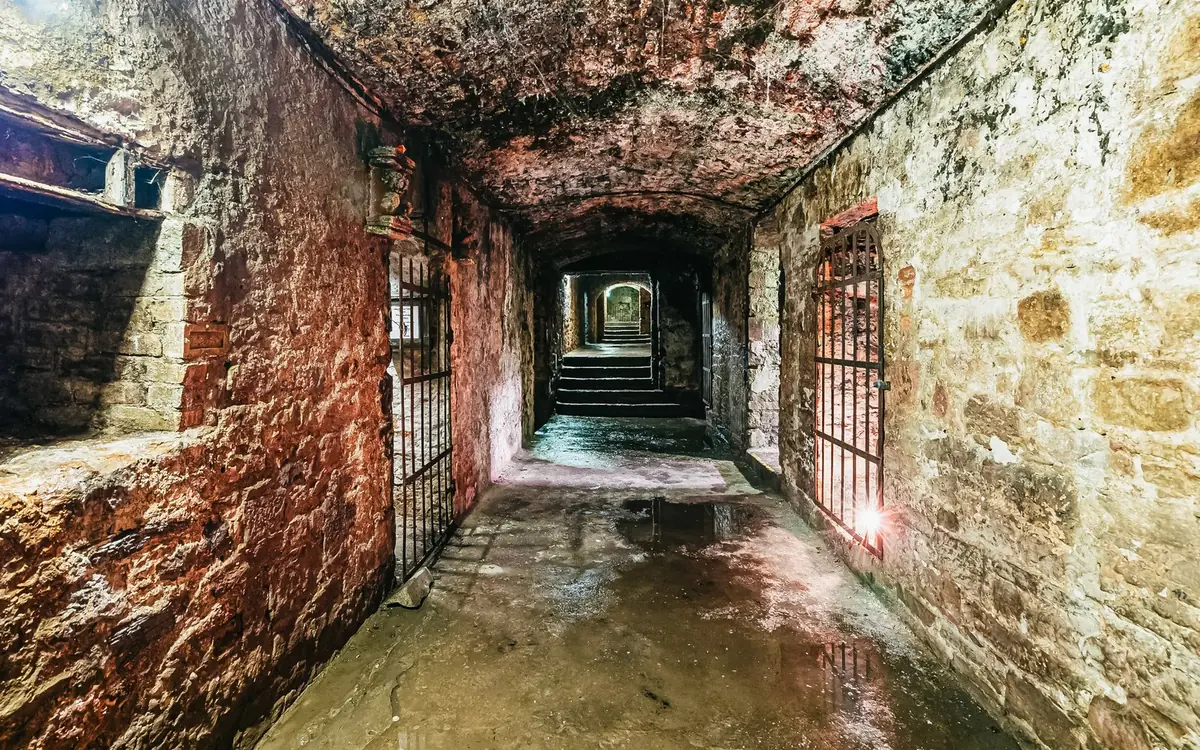
Quick answer
The short answer. The Edinburgh vaults are the chambers built into the nineteen arches of the South Bridge, completed in 1788. They are entered from Niddry Street and Blair Street, they are about ten degrees all year, and the only way in is a tour ticket. The cheapest is $25 for an hour. They are not the same place as the Real Mary King’s Close.
The vaults, by the numbers
- Bridge begun
- August 1785the South Bridge, over the Cowgate ravine
- Bridge completed
- 1788nineteen arches, only one of them visible
- Chambers built in
- ~120inside the arches, not under the road
- Room sizes
- 2 – 40 m²from a cupboard to a small hall
- Windows
- Noneand no drainage, and no ventilation
- Trade abandoned from
- 1795water came through the bridge deck
- Lived in until
- ~1860the poorest housing in an overcrowded city
- Then
- Filled with rubbleand forgotten for over a century
- Rediscovered
- 1980sNorrie Rowan broke through from above
- Excavated
- 1985finds confirmed people had lived down there
- Temperature
- ~10°Cthe same in July as in January
- Cheapest way in
- $25one hour, the standard vaults tour
The engineering
A bridge with rooms inside it
Nineteen arches, one of them visible, and about a hundred and twenty rooms inside the rest.
Edinburgh’s Old Town sits on a ridge running down from the castle, and the ground falls away hard on both sides. By the 1780s the city needed to expand south across the Cowgate ravine, and rather than level the hill it built a bridge over it: the South Bridge, begun in August 1785 and completed in 1788.
What makes it strange is that it does not look like a bridge. It has nineteen arches and exactly one of them is visible — the one that crosses the Cowgate. The rest are buried in the built-up ground on either side, with shops and tenements sitting on top of them. Walk up South Bridge today and you are walking on a viaduct that has been camouflaged as an ordinary street.
The arches were not left hollow. Builders formed roughly a hundred and twenty chambers inside them, ranging from about two square metres to about forty. That was the point: usable commercial space, right underneath the busiest new street in the city, at no extra cost in land.
It should have worked. It did not, for one reason that no tour guide has to exaggerate: the bridge deck above was never properly sealed, and there was no drainage below. Water came down through it. The chambers had no windows and no ventilation, so nothing dried. Within roughly thirty years the trades that had moved in were moving out again, and the record of abandonment starts as early as 1795.
The four lives of the vaults
From storage to rubble in seventy years
The chambers have had four distinct uses, and only the first was the one they were built for.
- 1788 – c. 1795: trade
Taverns, cobblers, cutlers, and storage for the merchants trading on the street above. This was the intended use and it lasted about a generation.
- c. 1795 – c. 1820: decline
Water through the deck, no drains, no air. Businesses left. The chambers slid out of the formal economy and largely out of the written record with it.
- c. 1820 – c. 1860: housing
People with nowhere else lived down there, in a city that was already among the most overcrowded in Europe. Almost nothing was written down about them at the time, which is exactly why the 1985 excavation mattered so much.
- c. 1860 – 1980s: nothing
Vacated, filled with rubble and sealed. For roughly a hundred and twenty-five years the chambers under one of the busiest streets in Scotland simply were not there as far as anyone was concerned.
The rediscovery
A rugby player and a hole in a wall
The vaults came back by chance. In the 1980s Norrie Rowan — a former Scotland rugby international who owned property above the arches — broke through into the space beneath his building. What he found was a warren of stone chambers packed with rubble.
Excavation followed, and in 1985 it turned up the evidence that settled the question: middens of domestic rubbish. Oyster shells, bottles, plates, toys. Not storage waste — the debris of people living. That single finding is the foundation of every vault tour operating in Edinburgh today, and it is the reason a guide can tell you the chambers were inhabited without hedging.
It is worth sitting with how recent that is. Your parents were alive when nobody knew these rooms were down there.
The vaults are locked outside tour hours. There is no public entrance, no self-guided option and no free way in — the ticket is the access.
What the free tours can and cannot do→Every trip, current fare
Every tour that goes into the vaults
Four of the twelve tours on this site enter the South Bridge chambers. The fifth underground tour goes somewhere else entirely — the Real Mary King’s Close.
| Tour | Length | Price | Underground | Cost per hour | Rating |
|---|---|---|---|---|---|
| Evening Underground Ghost TourInto the vaults after dark | 75 min | $24 | Yes, the vaults | $19.20 | 4.4 · 4,063 |
| Underground Vaults TourThe standard vaults tour, most reviewed in the city | 1 h | $25 | Yes, the vaults | $25.00 | 4.5 · 12,500 |
| Late-Night Vaults Terror TourThe late slot, run harder | 75 min | $27 | Yes, the vaults | $21.60 | 4.6 · 4,571 |
| Haunted Vaults & Graveyard TourGreyfriars and the vaults in one evening | 1.5 h | $27 | Yes, the vaults | $18.00 | 4.6 · 7,277 |
| Multi-Sensory Haunted UndergroundThe original Blair Street vaults tour | 75 min | $34 | Yes, Blair Street | $27.20 | 4.5 · 2,754 |
What it is like down there
Six practical things nobody mentions
None of this is designed to put you off. It is the stuff people say afterwards they wish they had known before.
- It is about ten degrees, always
Not cold enough to be unpleasant, cold enough to notice after forty minutes of standing still. A jumper is more useful than a heavy coat, which you will end up carrying.
- The air is completely still
No ventilation is not a figure of speech. It is the thing most people describe as the genuinely odd sensation, more than the dark.
- The ceilings are low and the doorways are lower
If you are tall you will duck repeatedly. The floors are uneven stone with no lighting to speak of, so sensible shoes are not a formality.
- The lights go out at some point
Almost every operator does this, for a minute, somewhere in the middle. It is the part everyone remembers. You can stand near the door and nobody will comment.
- Some vaults do not allow photographs
Operators vary. If photographs matter to you, check the listing before you build the evening around them.
- There is no phone signal
You are inside a bridge under a street. Arrange where to meet afterwards before you go down.
Blair Street or Niddry Street
The two entrances, and why it matters slightly
The tours do not all enter the same chambers. Two entrances are in regular use: Blair Street, on the west side of the bridge, and Niddry Street, on the east. Both open into chambers inside the same structure, but different operators hold different sections under different arrangements.
Practically, this changes two things. First, your meeting point: Blair Street and Niddry Street are a two-minute walk apart but they are not the same door, and in the dark that matters. Second, if you have already done one vault tour and are considering a second, ask which entrance it uses — a different section is at least a different set of rooms.
What it does not change is the substance. Same bridge, same dates, same story, same temperature. Anyone telling you one set of chambers is materially more haunted than another is selling.
The other underground
Why the close is not a vault
This is the single most common confusion in the city, and it costs people money.
The vaults are rooms inside a bridge. Nobody planned to live in them, they were never streets, and they have no daylight because they never had any.
The Real Mary King’s Close is a street. It ran down the north side of the Royal Mile like the dozens of others still there today, with houses on both sides and open sky above it. In 1753 the city built the Royal Exchange over the top of it, partly demolishing it and burying the rest. People carried on living in the surviving parts until 1902.
They are two separate sites, two separate tickets and two separate operators, about four minutes’ walk apart. One tour will not get you into both, and no listing will warn you that you have picked the wrong one.
Common questions
The Edinburgh vaults, answered
Are the Edinburgh underground vaults real?
Completely. They are the chambers built inside the arches of the South Bridge, which was begun in August 1785 and completed in 1788 — about 120 rooms of between two and forty square metres. The history is documented; the ghost stories attached to it are a separate question.
How do you get into the Edinburgh vaults?
Only on a tour. There is no public entrance and no self-guided option — the chambers are private property behind locked doors. Tours enter from Niddry Street and Blair Street and start at $25 for an hour.
Why were the Edinburgh vaults abandoned?
Water. The bridge deck above was never properly sealed and there was no drainage below, so the chambers were permanently damp. With no windows and no ventilation nothing dried out. Trade had begun leaving by 1795.
Did people really live in the Edinburgh vaults?
Yes. From roughly the 1820s to about 1860 the chambers housed the poorest people in a very overcrowded city. Almost nothing was recorded about them at the time; the proof came from the 1985 excavation, which found domestic middens — oyster shells, bottles, household debris.
Who discovered the Edinburgh vaults?
Norrie Rowan, a former Scotland rugby international, broke through into them from a property above in the 1980s. Excavation in 1985 confirmed they had been inhabited. Before that they had been sealed and rubble-filled for something like 125 years.
How cold are the Edinburgh vaults?
About ten degrees, all year round, in completely still air. Bring a jumper rather than a heavy coat — you will be carrying the coat.
Are the vaults the same as Mary King’s Close?
No, and this is the commonest mistake people make. The vaults are rooms inside a bridge. Mary King’s Close is a street that the city built over in 1753 and which was lived in until 1902. Different sites, different tickets, four minutes apart.
Are the Edinburgh vaults suitable for claustrophobic visitors?
Honestly, no. Low ceilings, narrow doorways, no windows, still air, and a deliberate minute in complete darkness. If that sounds unpleasant, take one of the four above-ground walks — you lose the access, not the history.
The city above
Why Edinburgh had to build a bridge over its own street
A ridge with nothing on either side of it, and a population that had nowhere to go.
None of this makes sense without the shape of the ground. The Old Town occupies a single ridge running east from the castle rock — a crag-and-tail formation left by a glacier, with the hard volcanic plug at the west end and a long tapering slope behind it. The Royal Mile runs down the spine of that slope. Everything else falls away.
To the north was the Nor Loch, a shallow polluted marsh that the city used as a dump and as a defence, drained from the middle of the eighteenth century and now Princes Street Gardens. To the south was the Cowgate ravine. In between, on a strip a few hundred metres wide, lived one of the most densely packed urban populations in Europe, stacked ten and twelve storeys high because there was nowhere else to put them.
By the 1780s the pressure was unmanageable and the city had two options: level the hill, or bridge the gaps. It bridged them. The North Bridge went over the drained loch towards the new Georgian grid; the South Bridge went over the Cowgate. Both were built to carry a street, not to look like bridges, and both were built up on either side until they vanished into the townscape.
That is the whole explanation for the vaults. They are not a secret and they were never intended to be mysterious. They are the inside of a piece of civil engineering that the city then hid, because hiding it was the point.
What the excavation found
The evidence that settled it
Almost nothing was written down about the people who lived in the chambers. What is known comes from what they left behind.
- Domestic middens
Not builders’ rubble or trade waste — household refuse, in the places you would expect households to put it. That distinction is what proved habitation rather than storage.
- Oyster shells, in quantity
Oysters were cheap food in eighteenth- and nineteenth-century Edinburgh, not a luxury. The shells are among the commonest finds anywhere in the Old Town.
- Bottles, plates and clay pipes
The ordinary furniture of a poor household. Nothing valuable, which is itself the point: anything worth taking went with the people who left.
- Toys
The find that changes how the site reads. Children lived in windowless rooms inside a bridge, and no census, rent book or parish record says so.
- No structural alteration
The chambers were not converted. People moved into rooms built for barrels and did what they could, which is why the archaeology is domestic and the architecture is not.
Go deeper
More on Edinburgh after dark
Every Edinburgh ghost tour
Twelve tours compared on price, length and which underground each one enters.
The closeReal Mary King's Close
A street built over in 1753 and lived in until 1902 — and the legend it did not earn.
The busThe ghost bus tour
Seventy-five minutes of comedy horror from a seat, and who it is really for.
KirkyardGreyfriars Kirkyard
The most-visited kirkyard in Scotland, and what the tours do there after dark.
WitchesThe witches of Edinburgh
What the trials actually were, and which tours tell it straight.
VerdictThe best ghost tour
Twelve tours ranked for one decision, with a straight answer at the end.