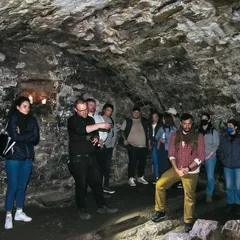
Above ground, and the oldest thing here
Greyfriars Kirkyard: the history, the Covenanters’ Prison and the night tours
Greyfriars is a burial ground granted by Mary, Queen of Scots in 1561, with a kirk built on it in 1620 — the first new church in Edinburgh after the Reformation. The National Covenant was signed there in 1638. Behind a locked gate at the far end is an enclosure that held around twelve hundred prisoners in the summer of 1679. All of that is documented, and all of it is older than every vault in this city.
Quick answer
The short answer. Greyfriars Kirkyard is free and open during the day. What a tour buys you is the evening, a guide, and — on some tours — the Covenanters’ Prison at the far end, which is behind a locked gate and cannot be entered otherwise. The cheapest tour that includes the kirkyard is $20; the ninety-minute kirkyard-and-vaults combination is $27.
Greyfriars at a glance
- Ground granted
- 1561by Mary, Queen of Scots
- Kirk built
- 1620first new church here after the Reformation
- National Covenant signed
- 1638in the kirk and kirkyard
- Covenanters’ Prison
- Summer 1679after the Battle of Bothwell Brig
- Prisoners held
- ~1,200in an enclosure at the far end
- That enclosure today
- Lockedauthorised guides only
- Greyfriars Bobby
- 1858 – 1872statue erected 1873
- Entry to the kirkyard
- Freedaylight hours
- Gates at night
- Closedwhich is why tours work the boundary
- Cheapest tour including it
- $20the Dark History walk
- With the vaults
- $271.5 hours, 7,277 reviews
- Best for
- Daylight historyand an evening walk, separately
The ground
Four hundred and sixty years of burials
A friary garden, then a burial ground, then the place a national document was signed.
Before the Reformation the site was a Franciscan friary garden — the Grey Friars, which is where the name comes from. In 1561 Mary, Queen of Scots granted the ground to the town as a burial place, because St Giles’ churchyard on the Royal Mile was full.
The kirk itself came later, in 1620, and has the distinction of being the first new church built in Edinburgh after the Reformation. In 1638 the National Covenant — the document that defined Scottish religious politics for the rest of the century — was signed there.
What that history leaves on the ground is a kirkyard of unusual density: table tombs, wall monuments, mortsafes, and the watch-house at the gate. The mortsafes and the watch-house both date from the body-snatching years of the 1820s, when medical schools in this city needed subjects and families paid to make sure their own were not among them. Guides use them, quite reasonably, as the most physical evidence in Edinburgh of a period everyone has heard of.
The prison
The enclosure at the far end
In June 1679 a Covenanter army was defeated at Bothwell Brig. Around twelve hundred prisoners were brought to Edinburgh, and with nowhere to put them the authorities used an enclosure in the south-west corner of Greyfriars Kirkyard. They were held there through the summer and into the autumn.
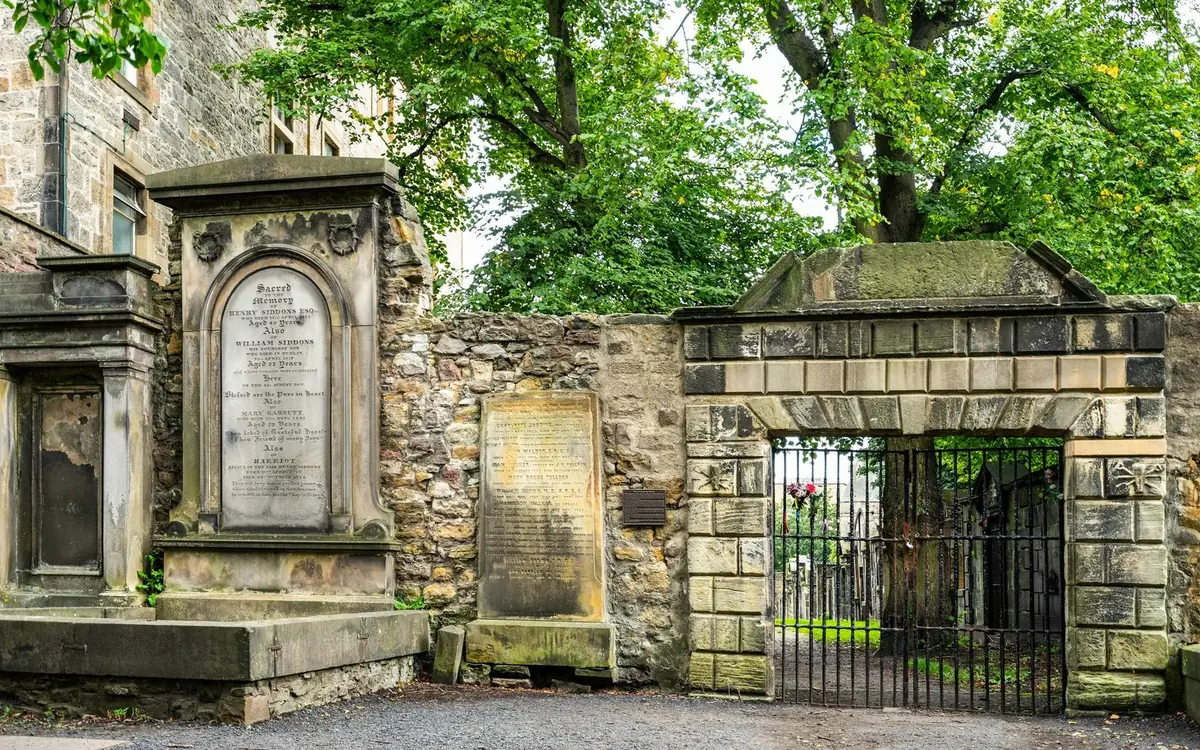
That enclosure is still there and it is still called the Covenanters’ Prison. It is behind a locked gate, and it is the single strongest argument for taking a guided tour rather than walking round the kirkyard yourself: the gate is opened for authorised guides and for nobody else.
Nearby is the Black Mausoleum of George Mackenzie, Lord Advocate under Charles II, who prosecuted Covenanters and is buried a short walk from the enclosure that held them. Reports of disturbances around the mausoleum date from 1999 and are the basis of most of what is now sold as the haunting. The seventeenth-century politics need no embellishment; the 1999 material is recent folklore and honest guides date it.
The kirkyard is free to walk into by day, and worth an hour on its own. What you cannot do alone is get through the gate at the far end, or be there after dark.
What free tours can and cannot reach→Visiting
Six things worth knowing before you go
Half of these apply whether you take a tour or walk in yourself on a Tuesday afternoon.
- It is free, and open in daylight
Walk in from Candlemaker Row or George IV Bridge. No ticket, no booking. An hour there in the afternoon is one of the better free things to do in this city.
- The gates close at night
Which is the whole reason evening tours work the way they do. Tours with access rights go in; the rest work the boundary and the surrounding streets, and a good guide makes that work.
- The Covenanters' Prison needs a guide
Locked gate, authorised access. If getting inside it matters to you, check that the specific listing says so before you book — not every kirkyard tour includes it.
- The ground is uneven and unlit
Four centuries of settling, on a slope, in the dark. Shoes with grip, and a phone torch you are prepared to not use because the guide asks.
- Bobby is at the gate, and is not the point
The Skye terrier said to have kept to his owner’s grave from 1858 to 1872 has a statue at the Candlemaker Row entrance from 1873. It is a nice story and it has nothing to do with why the kirkyard is historically significant.
- It is a working burial ground
People have relatives here. Tours that behave badly in kirkyards make life harder for the ones that do not, and the better operators are noticeably careful about it.
Every trip, current fare
Tours that include Greyfriars Kirkyard
Three of the twelve tours on this site work the kirkyard. One of them pairs it with the underground vaults, which for a first visit is the most complete evening on offer.
| Tour | Length | Price | Underground | Cost per hour | Rating |
|---|---|---|---|---|---|
| Dark History Walking TourThe cheapest walk, and it is a good one | 1.5 h | $20 | No | $13.33 | 5.0 · 72 |
| Ghosts, Mysteries & WitchesKirkyards, closes and the witch trials | 2 h | $22 | No | $11.00 | 4.9 · 32 |
| Haunted Vaults & Graveyard TourGreyfriars and the vaults in one evening | 1.5 h | $27 | Yes, the vaults | $18.00 | 4.6 · 7,277 |
Which one
Kirkyard alone, or kirkyard and vaults
If the kirkyard is the thing you actually want, the cheapest route in is the Dark History walking tour at $20. Ninety minutes, above ground throughout, and it covers Greyfriars, the Covenanters’ Prison and the Grassmarket. It holds a perfect 5.0, although across only 72 reviews, which is a small sample and worth saying.
If you want the kirkyard and the underground in one evening, the haunted vaults and graveyard tour at $27 is ninety minutes and does both. 7,277 reviews at 4.6 — the second-most-reviewed tour on this site. For somebody with one free evening in Edinburgh, this is probably the best single purchase available.
If you want two hours and a night walk through kirkyards and closes rather than anything underground, Ghosts, Mysteries and Witches at $22 is rated 4.9 and goes deeper into the witch trials than the others.
Common questions
Greyfriars Kirkyard, answered
Is Greyfriars Kirkyard free to visit?
Yes, during daylight hours, from Candlemaker Row or George IV Bridge. There is no ticket. What is not free and not open is the Covenanters’ Prison at the far end, which is behind a locked gate.
What is the Covenanters' Prison?
An enclosure in the south-west corner of the kirkyard where around 1,200 prisoners were held after the Battle of Bothwell Brig in June 1679. It is still there, still locked, and opened only for authorised guides.
How old is Greyfriars Kirkyard?
The ground was granted as a burial place by Mary, Queen of Scots in 1561. The kirk itself was built in 1620 and was the first new church in Edinburgh after the Reformation. The National Covenant was signed there in 1638.
Can you visit Greyfriars Kirkyard at night?
Not on your own — the gates close. Evening access is on a tour, and only some tours have rights to go through the gate at the far end. Check the listing rather than assuming.
Which tour includes Greyfriars Kirkyard?
Three on this site: the Dark History walk at $20, the Ghosts, Mysteries and Witches walk at $22, and the haunted vaults and graveyard tour at $27, which pairs the kirkyard with the underground.
Is Greyfriars Kirkyard haunted?
That depends what you will accept as evidence. The reports around the Black Mausoleum date from 1999, not from the seventeenth century, and honest guides say so. The documented history — 1561, 1620, 1638, 1679 — is older and considerably more interesting.
Where is Greyfriars Bobby?
The statue is at the Candlemaker Row entrance and dates from 1873. The dog is said to have kept to his owner’s grave from 1858 to 1872. It is the most photographed thing at the kirkyard and the least historically important.
How long do you need at Greyfriars?
An hour on your own in daylight is enough to see the tombs, the mortsafes and the watch-house. A guided evening tour runs 90 minutes to two hours and covers the surrounding Old Town as well.
The mortsafes
Iron cages over graves, and why they are there
Iron over graves, a watch-house at the gate, and a law that ended it in 1832.
Walk round Greyfriars in daylight and you will see heavy iron frames set over or around certain graves, and a small building at the gate. Both belong to the same short period and the same problem.
In the first decades of the nineteenth century Edinburgh had one of the leading medical schools in Europe and a legal supply of cadavers that came nowhere near meeting its teaching demand. The gap was filled unlawfully, and families responded by physically securing new graves: iron mortsafes, weighted covers, and rotas of relatives keeping watch from a purpose-built watch-house until the body was of no further use to anybody.
The Anatomy Act of 1832 changed the law and the practice stopped almost at once. The ironwork stayed, which is why Greyfriars is one of the best places in Britain to see the physical evidence of a period that everyone has heard about and almost nobody has seen traces of.
It is also the least supernatural thing in the kirkyard and the one guides tend to spend least time on, which is a shame — it is a story about ordinary families and a bad law, and the objects are right there.
What to look for
Six things in the kirkyard, all free to see
An hour here in daylight costs nothing. This is what to walk towards.
- The Covenanters’ Prison gate
At the south-west end. Locked, and opened only for authorised guides. Even from the outside it is the most historically loaded spot on the ground.
- The mortsafes
Scattered among the nineteenth-century graves. Heavy iron frames, unmistakable once you know what they are.
- The watch-house
By the entrance. Small, plain, and built for people sitting up all night beside a family grave.
- The table tombs
Flat slabs raised on pillars, the standard high-status burial of the seventeenth and eighteenth centuries. Several carry carved skulls and hourglasses.
- The Black Mausoleum
George Mackenzie’s tomb, near the prison enclosure. The reports attached to it date from 1999; the man himself died in 1691.
- The view to the castle
From the upper path. The kirkyard sits below the rock, and the sightline explains the geography of the Old Town better than any map.
Go deeper
More on Edinburgh after dark
Every Edinburgh ghost tour
Twelve tours compared on price, length and which underground each one enters.
UndergroundThe Edinburgh vaults
About 120 rooms inside a bridge, abandoned by 1795 and lost for a century.
The closeReal Mary King's Close
A street built over in 1753 and lived in until 1902 — and the legend it did not earn.
The busThe ghost bus tour
Seventy-five minutes of comedy horror from a seat, and who it is really for.
WitchesThe witches of Edinburgh
What the trials actually were, and which tours tell it straight.
VerdictThe best ghost tour
Twelve tours ranked for one decision, with a straight answer at the end.