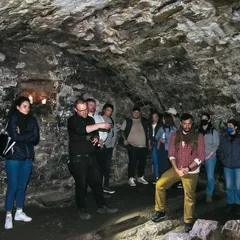
A street with a building on top of it
The Real Mary King's Close: what is down there, and what is only a story
A close is a narrow lane running off the Royal Mile, and Edinburgh still has dozens of them. Mary King’s Close was one more until 1753, when the city started building the Royal Exchange over the top of it — knocking down the upper storeys and keeping the lower ones as foundations. People went on living in what was left until 1902. That is the genuinely remarkable thing about this place, and it is not the story most tours lead with.
Quick answer
The short answer. The Real Mary King’s Close is a buried street under the City Chambers on the Royal Mile, not a vault and not part of the South Bridge chambers. Tours run about an hour and cost $36. It is the most historically careful underground hour in Edinburgh — and the famous plague-sealing legend is not supported by the record.
Mary King's Close at a glance
- What it is
- A streetnot a vault, not a cellar
- Where
- Under the City Chambersentrance off the Royal Mile
- Named after
- Mary Kinga burgess who traded in fabric there
- She died
- 1644the Edinburgh plague came the year after
- Built over from
- 1753the Royal Exchange, finished 1761
- What survived
- The lower storeyskept as foundations for the new building
- Lived in until
- 1902the last resident was a saw maker
- He was paid
- £400a compulsory purchase to leave
- Opened to visitors
- 2003as the Real Mary King’s Close
- Tour length
- 1 hourguided throughout, in period costume
- Price
- $36the most expensive tour on this site
- Rating
- 4.7 · 4,405live from the listing
The street
Why a lane off the Royal Mile ends up indoors
The city did not seal the close. It used it as a foundation and put a building on it.
Edinburgh’s Old Town runs down a ridge from the castle, and the ground drops away so sharply on either side that the lanes leading off the Royal Mile are less streets than staircases. They are called closes, they are numbered in the dozens, and Mary King’s Close was an ordinary one: houses several storeys high on both sides, open sky above, a steep descent towards the Nor Loch.
It takes its name from Mary King, the daughter of an Edinburgh advocate, who traded in fabric and was living on the close in the 1630s. She died in 1644. The plague reached the city the following year — which is the coincidence that a lot of the folklore is built on, and it is worth noticing that the order is the wrong way round.
What changed the close was not disease but civic ambition. In 1753 the town began building the Royal Exchange — the building that is now the City Chambers — and the site it chose was the top of Mary King’s Close. The upper storeys of the houses were demolished. The lower storeys were kept, because they were sound and because they made a convenient foundation. The new building went up on top, and the street simply became an interior.
The last resident
Somebody lived there until 1902
This is the fact that ought to be the headline and almost never is. The close was not abandoned when the Royal Exchange went up. Parts of it stayed in use, and parts of it stayed inhabited, for another century and a half.
The last resident was Andrew Chesney, a saw maker, who was still living there in 1897 and left in 1902 when the corporation took the property under a compulsory purchase. He was awarded four hundred pounds.
Sit with that for a moment. There was a man making saws in a house on a street with a municipal building on top of it, in living memory of people whose grandchildren are alive now. No ghost story on any tour in this city is stranger than that, and it is entirely documented.
If what you want is the South Bridge chambers rather than a buried street, that is a different site and a different ticket — and it is eleven dollars cheaper.
The underground vaults, explained→The legend, examined
Four claims you will hear, and what the record says
None of this makes the tour worse. The documented version is stranger than the folklore, and the operator’s own guides are more careful than the internet is.
- "Plague victims were sealed in and left to die"
Not supported by the record. The close was partly demolished and built over in 1753, more than a century after the 1645 plague, and people continued to live in it until 1902. It is a superb story and it is folklore.
- "Nobody would go near it because of the lights"
Reports of strange lights over the site are old and real enough as reports. The explanation usually cited is biogas drifting up from the Nor Loch — the polluted marsh that sat where Princes Street Gardens are now, and which the city used as a dump for centuries.
- "It is one of the Edinburgh vaults"
It is not. The vaults are chambers inside the arches of the South Bridge, four minutes’ walk away, built forty years later and never intended as housing. Two sites, two operators, two tickets.
- "Annie’s room is the oldest part of the legend"
It is the newest. The room and its offerings of dolls date from a psychic’s visit in 1992 and everything about it postdates the site opening to visitors. Guides will generally tell you so if you ask.
The hour itself
What the tour is actually like
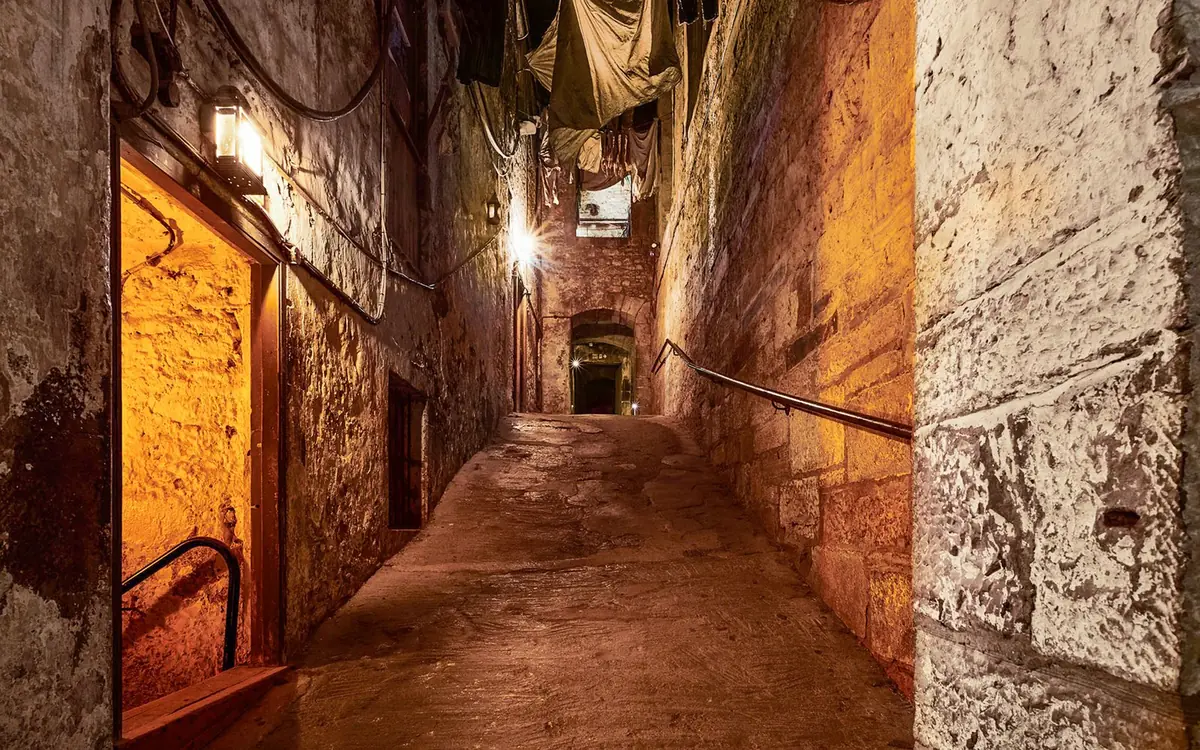
It is the most conventional underground hour in Edinburgh, and that is a compliment. You go in through a door on the Royal Mile beside the City Chambers, down a stair, and out onto what is unmistakably a street — sloping, cobbled, with doorways and window openings in the walls on either side and a ceiling where the sky used to be.
The guide is in period costume and works a character, which sounds worse than it is; the good ones use it to hold together an hour of genuine social history about how a seventeenth- and eighteenth-century Edinburgh household actually functioned. There are reconstructed rooms. There is a section on the plague that is careful about what is known.
It is not frightening. Groups are managed, the lighting is designed, and nobody jumps out at you. If you came to Edinburgh to be scared, book a vault tour instead. If you came to understand the city, this is the best hour on this site and it is worth the eleven-dollar premium.
Practical detail
- Where you meet
- Royal Milebeside the City Chambers, Warriston’s Close
- Nearest station
- Waverley5 minutes on foot, uphill
- Underground
- Yesbut a street, not a vault
- Temperature
- Coola jumper is enough
- Steps
- Yes, several flightsand the close itself is steep
- Photography
- Not permittedinside the close
- Duration
- 1 hourguided throughout
- Groups
- Managed, timed entrynot a walk-up site
- Booking
- Essentialslots sell out in October
- Cancellation
- Free to 24 hthrough GetYourGuide
Every trip, current fare
Mary King's Close against the underground alternatives
The close is the most expensive ticket here and the only one that is a street rather than a set of rooms. These are the four tours people weigh against it.
| Tour | Length | Price | Underground | Cost per hour | Rating |
|---|---|---|---|---|---|
| Underground Vaults TourThe standard vaults tour, most reviewed in the city | 1 h | $25 | Yes, the vaults | $25.00 | 4.5 · 12,500 |
| Late-Night Vaults Terror TourThe late slot, run harder | 75 min | $27 | Yes, the vaults | $21.60 | 4.6 · 4,571 |
| Haunted Vaults & Graveyard TourGreyfriars and the vaults in one evening | 1.5 h | $27 | Yes, the vaults | $18.00 | 4.6 · 7,277 |
| Multi-Sensory Haunted UndergroundThe original Blair Street vaults tour | 75 min | $34 | Yes, Blair Street | $27.20 | 4.5 · 2,754 |
| Real Mary King's CloseA street the city built over in 1753 | 1 h | $36 | Yes, the close | $36.00 | 4.7 · 4,405 |
Common questions
Mary King's Close, answered
What is the Real Mary King's Close?
A street off the Royal Mile that the city partly demolished and built the Royal Exchange over from 1753, keeping the lower storeys as foundations. Parts of it stayed inhabited until 1902. It opened to visitors in 2003 and tours run about an hour.
Were plague victims sealed into Mary King's Close?
The record does not support it. The close was built over more than a century after the 1645 plague and was lived in until 1902. The strange lights people reported over the site are more plausibly explained by biogas from the Nor Loch, the marsh that used to lie where Princes Street Gardens are now.
How much is a Mary King's Close ticket?
$36 for the guided hour on this site, with free cancellation up to 24 hours before. It is the most expensive tour listed here and the only one that takes you into a buried street rather than a vault.
Is Mary King's Close the same as the Edinburgh vaults?
No. The vaults are chambers built inside the arches of the South Bridge, completed in 1788. The close is a street built over in 1753. They are four minutes apart, run by different operators, and one ticket never covers both.
Who was Mary King?
The daughter of an Edinburgh advocate, a burgess in her own right, and a fabric merchant who lived on the close in the 1630s. She died in 1644, the year before the plague reached the city — which is the wrong way round for most of the folklore.
Is Mary King's Close scary?
No, and it does not try to be. It is a costumed history tour underground, with managed groups and designed lighting. If you want to be frightened, the late-night vault tours are what you are looking for.
Can you take photographs in Mary King's Close?
No — photography is not permitted inside. Plan the evening accordingly if pictures matter to you.
Is Mary King's Close suitable for children?
Better than most underground tours here, because it is history rather than fright and the route is managed. It is still enclosed, several flights down, and an hour long. Check the age minimum on the listing before booking.
The Royal Exchange
The building that swallowed a street
Built in 1753 for merchants who would not use it. The buried half outlasted the purpose.
The building on top of Mary King’s Close is not a quirk of later development. It was a deliberate civic project, and it failed at the thing it was built for.
Work on the Royal Exchange began in 1753 and finished in 1761. The intention was to give Edinburgh’s merchants a covered place to do business, off the street. The merchants declined to use it. They had conducted their trade for generations standing outside on the Royal Mile, at the Mercat Cross, and they carried on doing exactly that.
So the building sat largely unused for its stated purpose and drifted into municipal hands. It is the City Chambers today, and it has been the seat of Edinburgh’s local government for most of two centuries.
The irony is worth holding on to. A street full of houses was demolished down to its lower storeys to make room for a merchants’ exchange that the merchants refused to enter — and the part that survives, and that people now pay to see, is the part that was supposed to be thrown away.
What you actually walk through
Six things on the route
The close is not one room. It is a street with buildings off it, and the tour moves through several distinct spaces.
- The close itself
Sloping, cobbled, with door and window openings in the walls on both sides and a ceiling where the sky was. It is unmistakably an exterior space that ended up with a roof over it.
- Ground-floor rooms
The surviving lower storeys of the houses, opening off the close. Low, dark, and much smaller than a modern visitor expects a whole family to have occupied.
- Reconstructed interiors
Furnished to show how a seventeenth- and eighteenth-century household actually used the space. This is where the tour earns its price against a walking tour.
- The plague section
Handled with more care than the folklore around this site would suggest. The 1645 outbreak is real history; the sealing legend is not, and the guides generally say so.
- Annie’s room
The shrine of donated dolls. Worth knowing that it dates from a psychic’s visit in 1992 and is the newest thing on the tour, not the oldest.
- The foundations
Where the seventeenth-century stonework meets the eighteenth-century building put on top of it. The clearest thing on the tour, and the one that explains the whole site in a glance.
Go deeper
More on Edinburgh after dark
Every Edinburgh ghost tour
Twelve tours compared on price, length and which underground each one enters.
UndergroundThe Edinburgh vaults
About 120 rooms inside a bridge, abandoned by 1795 and lost for a century.
The busThe ghost bus tour
Seventy-five minutes of comedy horror from a seat, and who it is really for.
KirkyardGreyfriars Kirkyard
The most-visited kirkyard in Scotland, and what the tours do there after dark.
WitchesThe witches of Edinburgh
What the trials actually were, and which tours tell it straight.
VerdictThe best ghost tour
Twelve tours ranked for one decision, with a straight answer at the end.